

How Can I Get The Detail I Want In My Drawing
Index
- Introduction
- Simplifying Objects and Understanding them in Perspective
- Values (Foreground, Centre-Ground & Background)
- Conceptualizing the Scene (sketch)
- Lineart
- Coloring and Shading
- Finishing Touches
- Image Formats and Exporting
1. Introduction
When creating illustrations, nosotros often brand the fault of wanting to put in then many details that in the end nosotros overload the prototype, losing the meaning we originally wanted it to convey.
In this tutorial I will teach you how to include lots of elements in an illustration in a manner that keeps information technology from looking besides busy and keeps the main element you want highlighted clearly in the line of sight of the viewer.
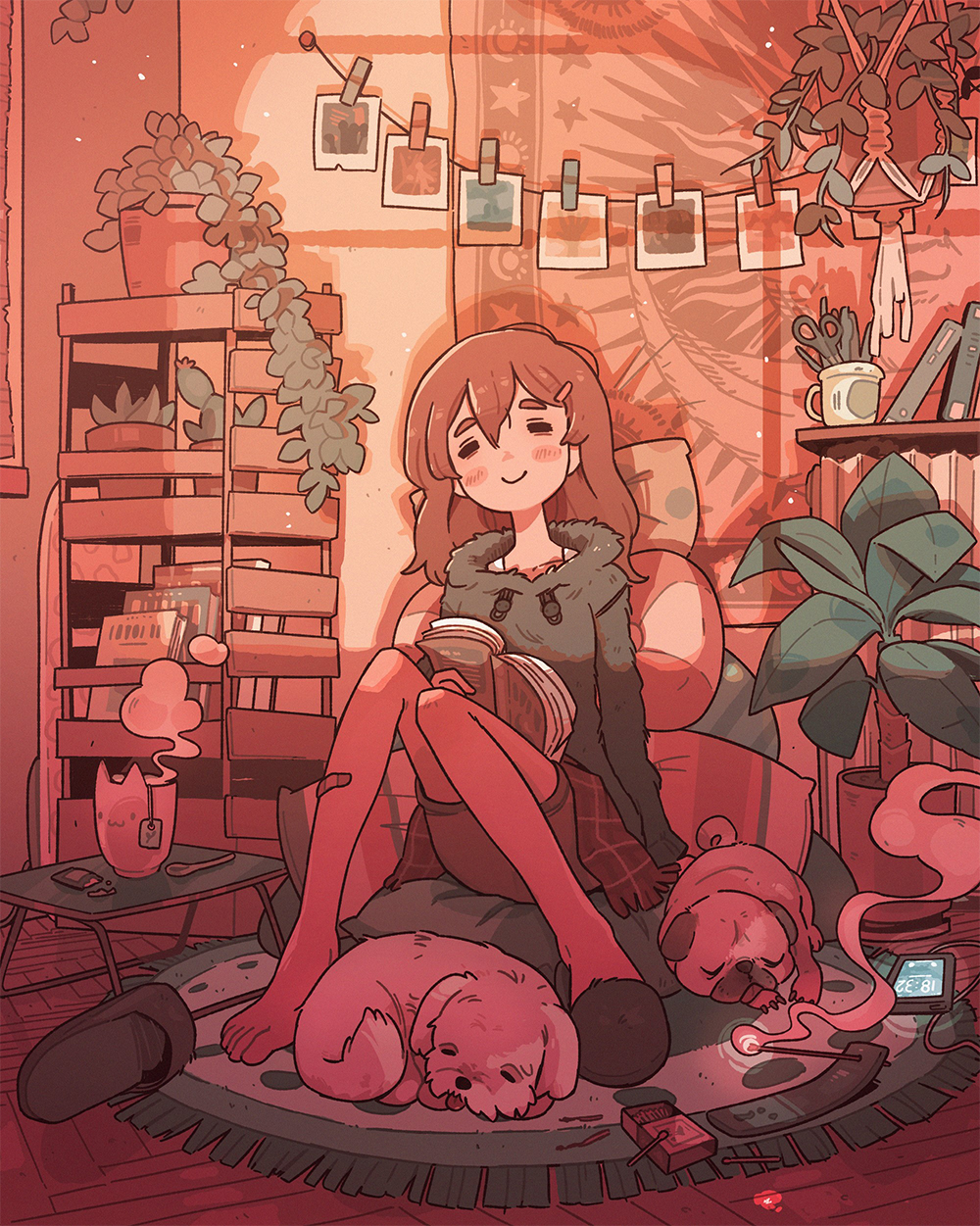
To create the illustration for this tutorials I have used two dissimilar pieces of software:
- Prune Studio Paint (CSP) for sketching and digital inking.
CSP has a castor stabilizer that makes your lines very comfortable and fluid. This (in my opinion) makes this software platonic for both inking and sketching your illustrations.
- Photoshop (PSD). For coloring and terminal castor-up.
Every bit PSD is specially designed for photo editing, information technology has lots of options in terms of coloring and post-production of images, making digital coloring very easy.
2. Simplifying Objects and Understanding them in Perspective
For whatsoever illustration (be it unproblematic or more complex) you must sympathise that whatever element that appears in it, be it a character or an object in the environment, can be simplified into geometric shapes. This will save yous a lot of time when locating whatever element within the perspective drawing.
The most common (and easy to make) shapes are cubes, cylinders, spheres, and pyramids.
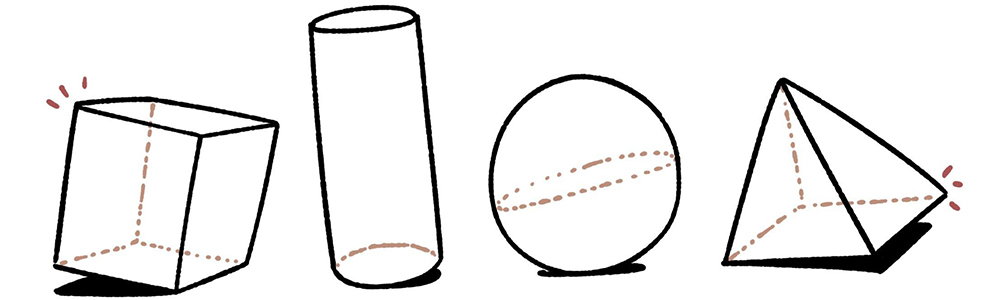
It is very important to know the nuts of perspective earlier nosotros first to make any drawing of this type. But to streamline the procedure, I think information technology is also very important to empathize perspective instinctively. i.east., to exist able to locate whatsoever of the elements mentioned above at any point in space without using vanishing points. This volition aid yous a lot when you want to insert many objects in a unmarried epitome without having to make many unlike vanishing points.
The post-obit is an do that helps to strop this instinct: take a photo of a space (a street or a room) and try to create different geometric shapes inside the image without using vanishing points. Apply only the perspective of the photo as a reference for the placement of the figures.
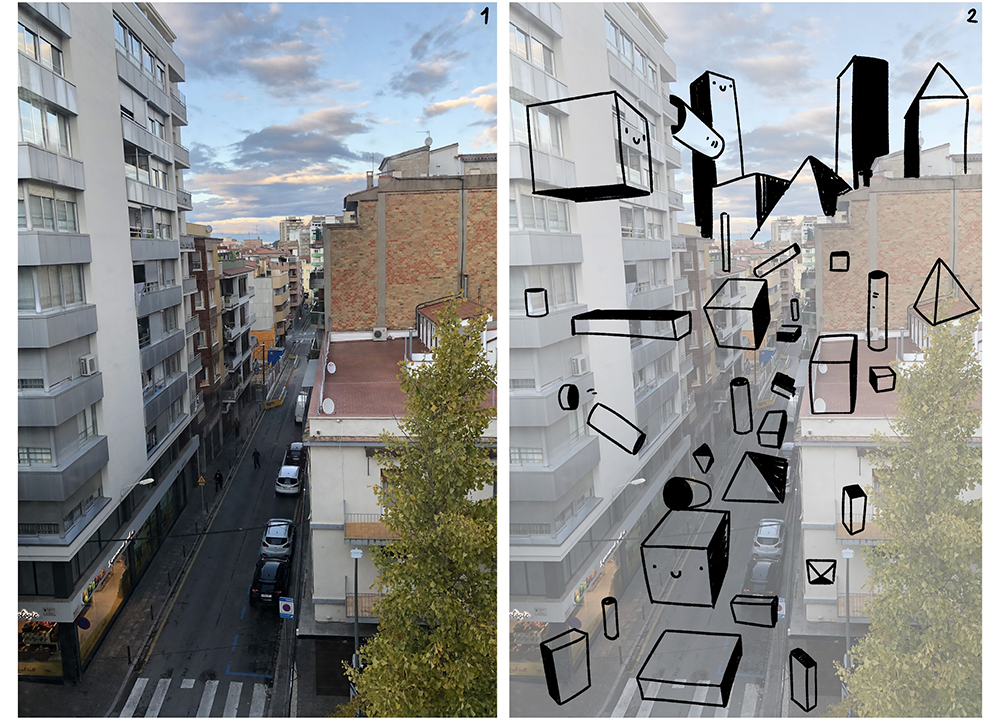
If you lot utilize the concept of this practise to the analogy that you want to make (I will utilise the tutorial illustration equally an example) you will be able to create a base which you will be able to draw over very easily.
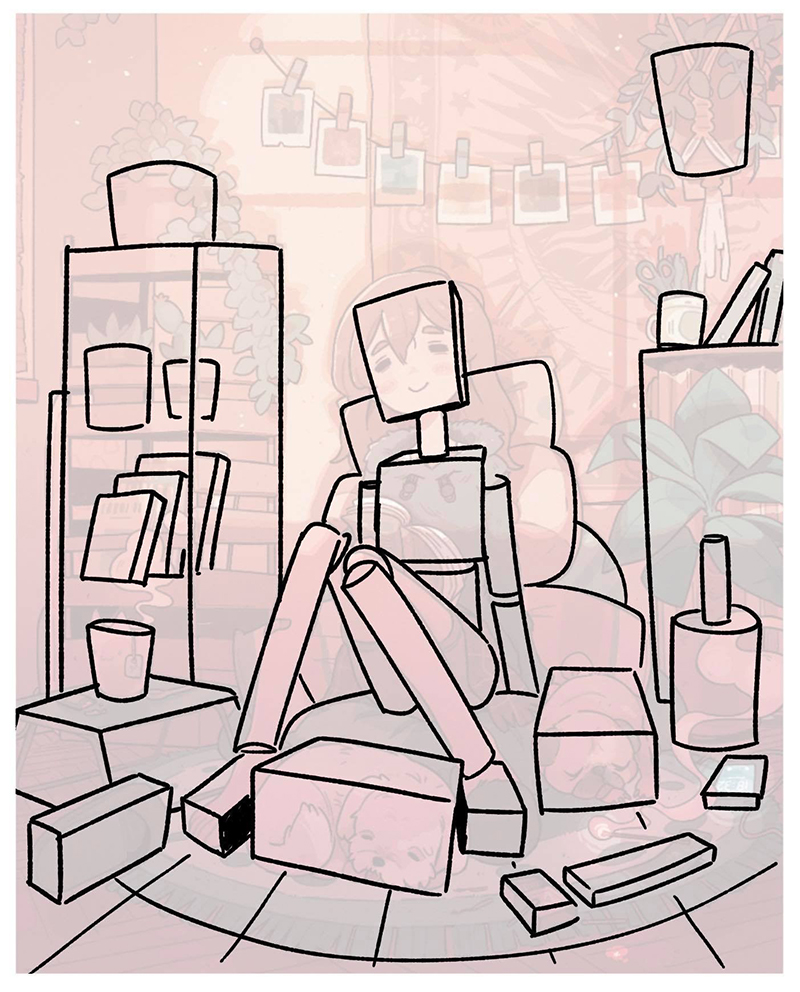
In the aforementioned style you just used the perspective of the photo as a reference to brand the geometric figures, you can use the perspective of these reference figures to brand fifty-fifty more detailed figures! Showtime elementary and little past little yous tin can increment the complexity.
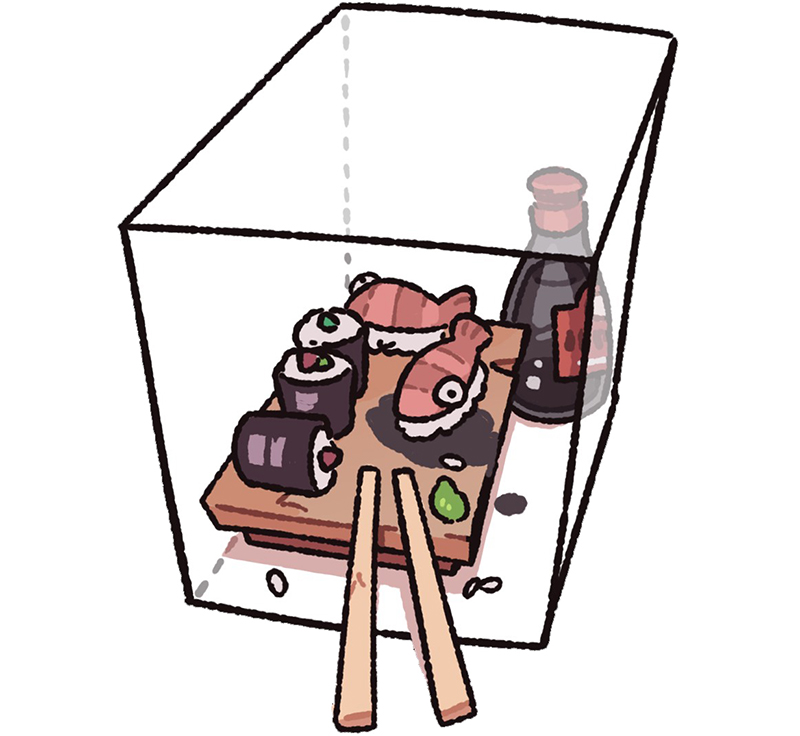
I conclude this section by emphasizing how important information technology is to understand the object yous are drawing, so using references is highly recommended.
three. Values (Foreground, Heart-Footing & Background)
The best mode to brand dynamic and in-depth compositions is by keeping the Foreground, Eye-Ground, and the Background in mind. As their names suggest, this is all nigh organizing the elements of your analogy by their altitude from the viewpoint.
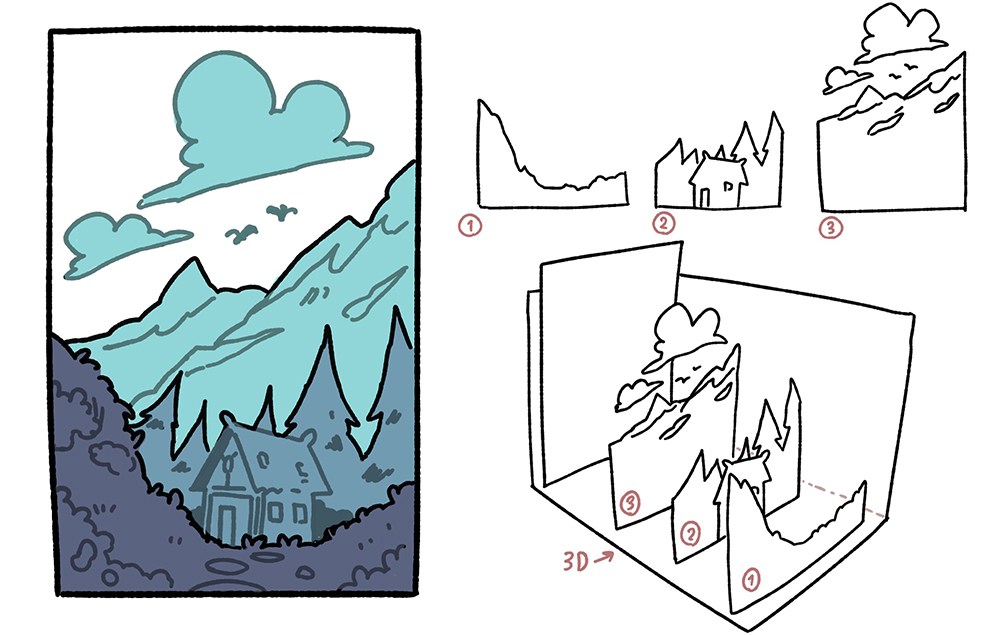
1 (foreground), two (middle-ground), and iii (background)
Depending on the complexity of the image, yous can accept more than i Middle-Ground, every bit in the piece beneath:
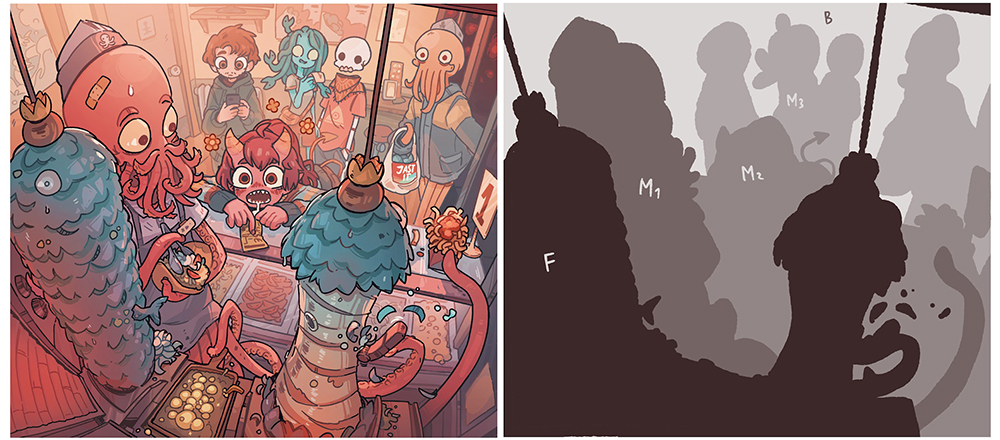
Note: Separating the elements into different blocks volition as well assist you lot when you go to coloring. The reason is that information technology helps you lot keep all the elements organized.
four. Conceptualizing the Scene (sketch)
Adjacent, I volition explain the way I sketch most of my drawings. Behave in listen that making an illustration is a very subjective matter and, in the end, we all accept our ain ways of working comfortably.
For this drawing, I knew that I wanted to bear witness a girl resting with her animals in a very relaxed surroundings, so I started doodling until I found one that convinced me. At this signal in the process, I don't focus on the final image – I just retrieve about the idea and how I want the objects to be distributed throughout the scene. I usually use an isometric perspective (especially for interiors) since it makes it a lot easier to locate elements inside the image.
Once I finally accept an idea that I like, I draw a crude sketch of what the event would await similar in terms of composition. I retrieve the trick hither is to think about where yous would position your camera if yous wanted to take a photo of the scene. These rough sketches are only for y'all to figure out the limerick of the piece, so don't worry about making them clean and cute. Here, I try to utilise what I explained in sections ii and 3 in a more than intuitive way.
When the rough sketch is washed, I kickoff to create the final sketch. Using the rough sketch I fabricated earlier, and looking at references for objects I want to put in the scene, I draw the details and elements of the image and so that everything I want to put in the analogy is articulate. At this point, I also think near how the lighting will affect the final picture show.
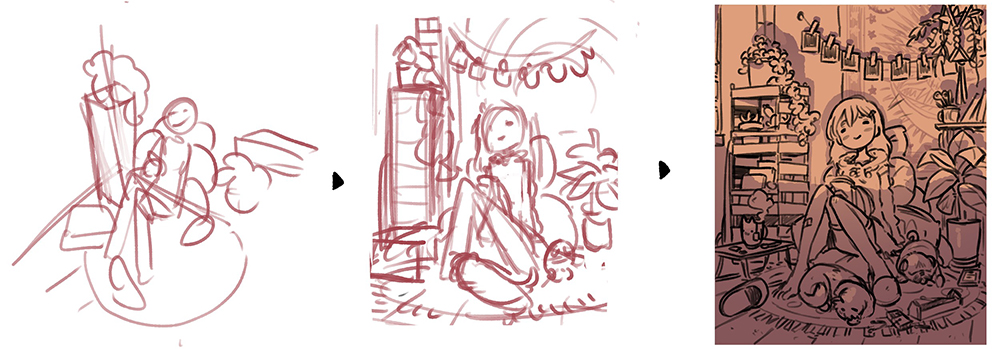
As I said earlier, the focal point of the image is the resting girl , so, to make her compositionally stand out, I need a lot of particular in all the elements that environment her, but also to leave a space between them then that her face up tin can be quickly identified by the viewer. I take also taken advantage of the shadow in the paradigm to "divide" the drawing in two and help the viewer apace focus on the girl'due south confront, since it is too easy for our eyes to fall to the lower surface area of the drawing. With this shadow, I am also able to create that relaxed atmosphere that I wanted for this prototype.
Finally, it is very important that, if at that place is something y'all're not certain on how to describe, start with something very elementary and gradually add complication to it.
Note: For all my sketches in CSP I apply a custom Turnip castor with pressure opacity, 36% pressure and 59% random.
5. Lineart
One time you have a defined sketch, doing the line art is very simple. It takes though a lot of patience (and references) to become information technology exactly how it is in your mind. This phase is very important to make your life easier in the coloring stage of the process. Personally, I do the lineart in blocks, separating each group of elements by where they are in image, as you tin can see below:
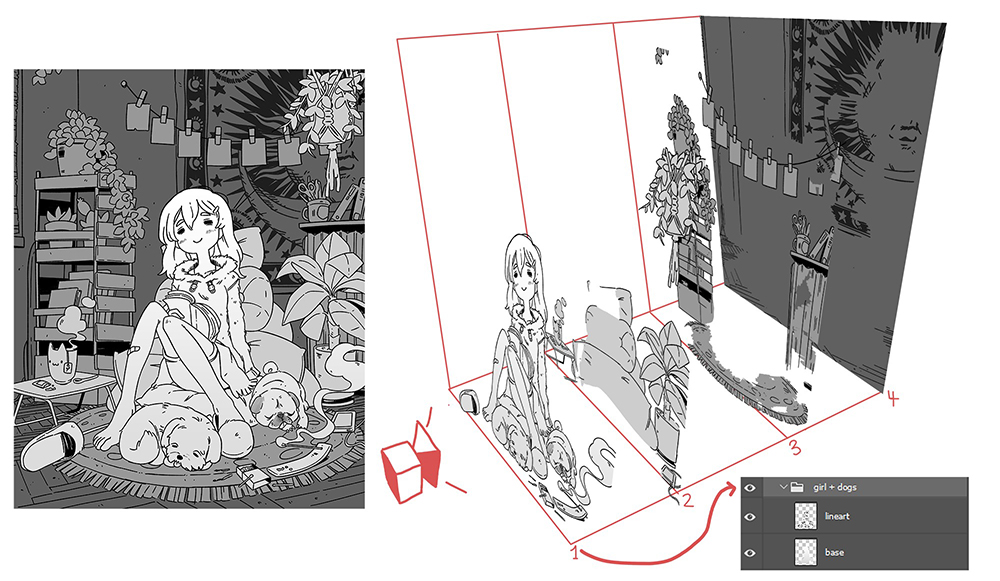
Each block has its own lineart and base color. In this example, they are divided into 4 different folders. Organizing the illustration in this way allows you to split the drawing into several sections, making the process of coloring and shading much easier.
Notation: To brand my lineart I utilize the same custom Saji castor that I used in the sketch, but this fourth dimension I don't use pressure opacity.
6. Coloring and Shading
Once I have finished my lineart, I export the certificate as a PSD file and start adding shadows. In this case, since there is simply 1 light source, I created the shadows on a unmarried layer with the Multiply blending way.
Cheers to the fact that I split the lineart into sections in the previous section, the coloring goes much faster since I tin focus on each section of the drawing separately. At this stage, I prefer to think about the specific colors of each individual element rather than most them equally a group.
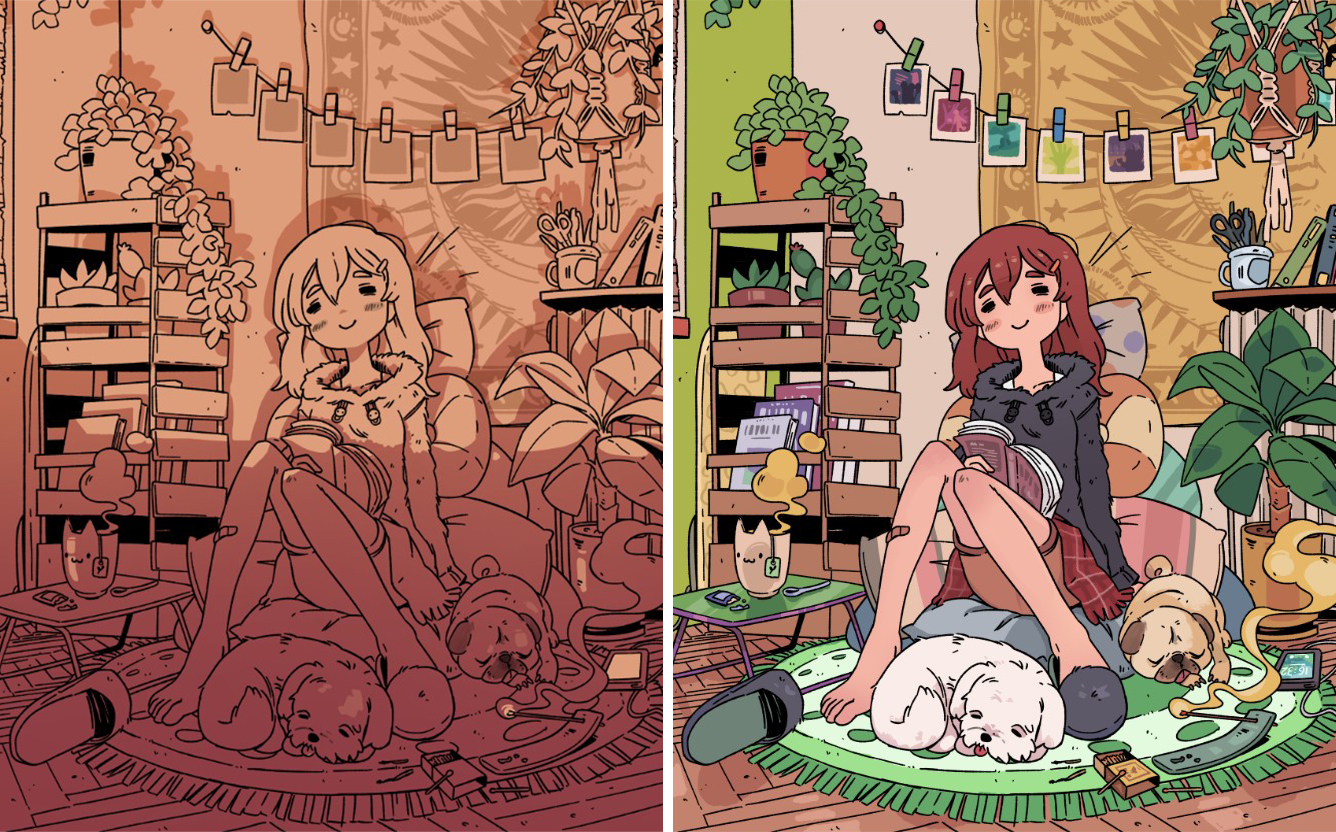
Shading (left) and colors (right)
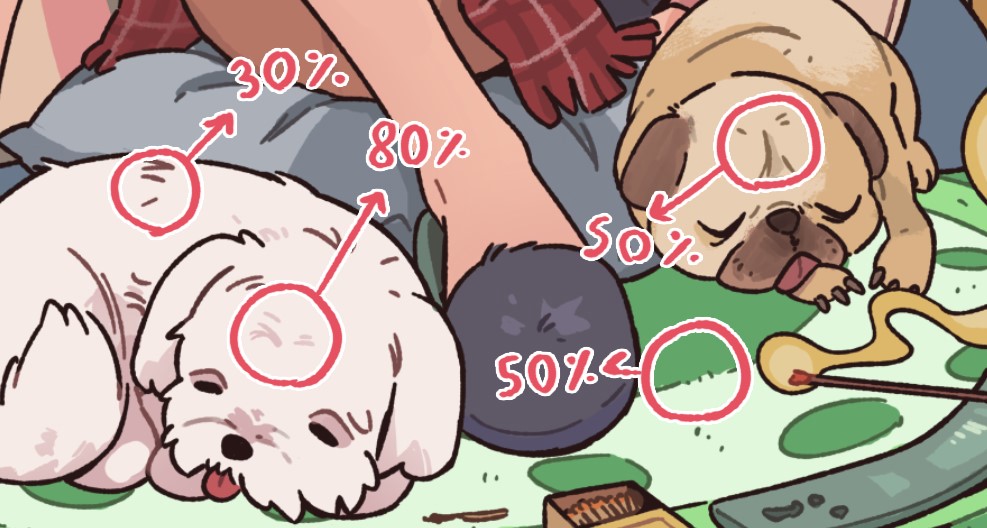
At this point, I like to paint the lineart inside the elements. This is a part of my personal style, simply I think it helps me make the image less loaded, as these colour lines are not also nighttime. This is the process that I follow:
- Lock the layer where the lineart is.
- Choose the master color within the line, or, if the color is too neutral, (as with this white dog), choose a similar only more saturated color (in this example, a very calorie-free ruby).
- Depending on the issue I want to achieve, I increase or decrease the brush'south opacity (in the screenshot beneath y'all tin run into the different opacities that I accept used in each part).
When we bring the shading layer and base colors together, this is what the cartoon looks like:
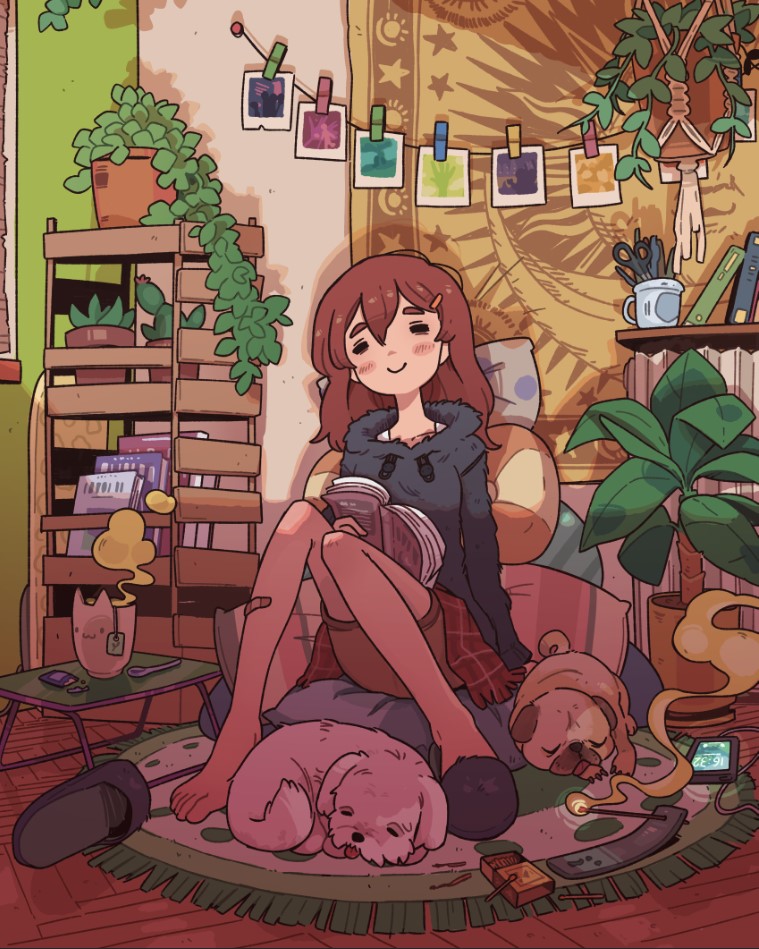
7. Finishing Touches
At this bespeak, I simply finish bringing everything I have so far together.
To get the sunset mood that I was looking for, I use PSD's orange photo filter, along with a layer in the Overlay blending mode, where I highlight the warm tones of the paradigm using a more than yellowish/orangish hue for the light and a slightly lilac/reddish color for the shadows.
Note: In situations like this, using the Colour Lookup adjustment layer tin can assistance a lot, as it includes several color presets that can greatly improve the last attribute of your artwork.
Once you lot have the colors and shading you were looking for, just add the final touches on the drawing. To further focus the image on the daughter, I decided to make the shadow a bit wider (to make information technology wait like part of a window). This way I tin can create a kind of circle effectually the girl, which directs the eyes to the center of the illustration.
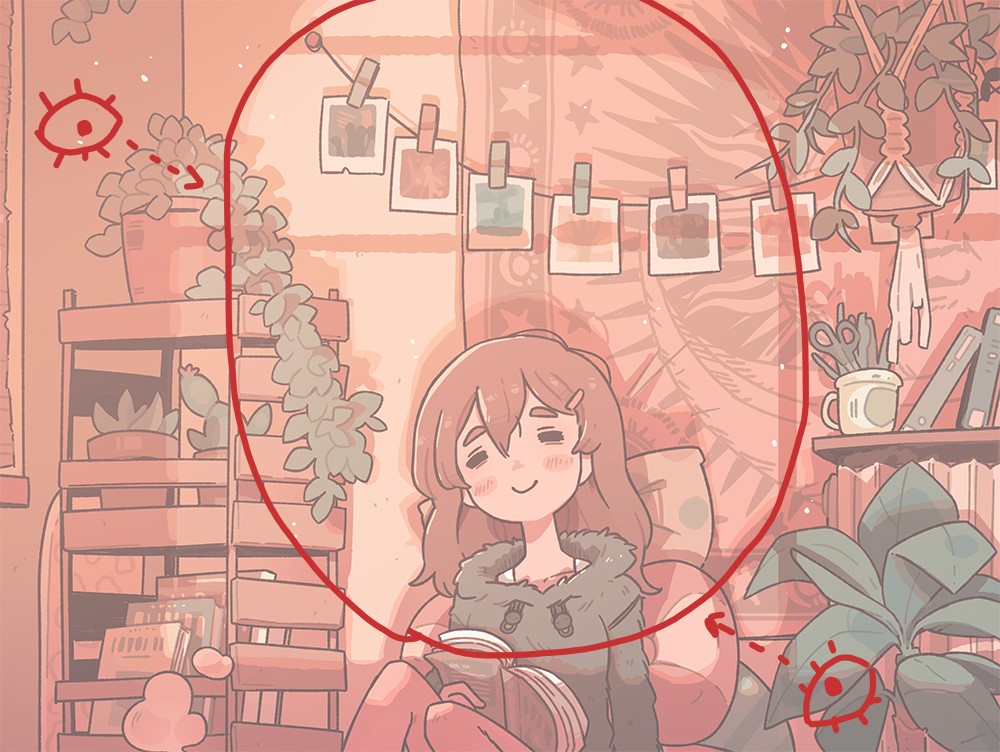
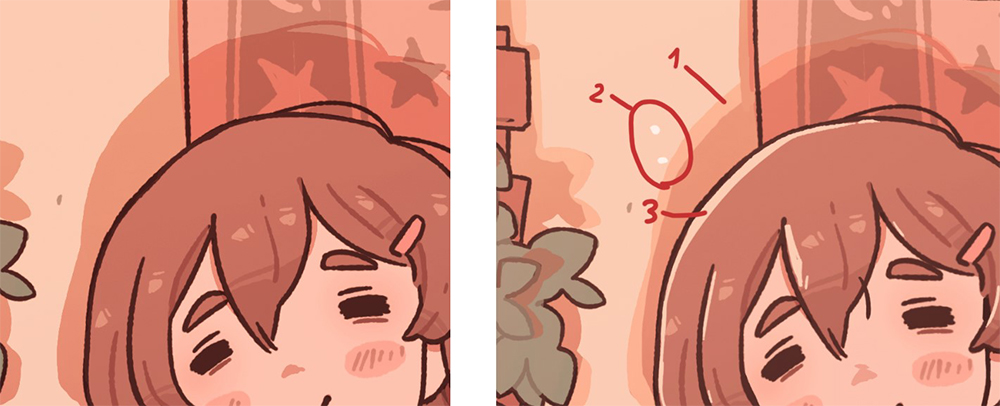
Notes:
(i) I recommend going over the edges of the shadows with another Overlay layer where the light is stronger.
(2) When stiff light enters a room, you can also see shiny specks of dust, similar the ones I added all over the drawing.
(3) Adding flat colors of the master calorie-free color on specific surfaces (such as hair) makes them stand up out more than.
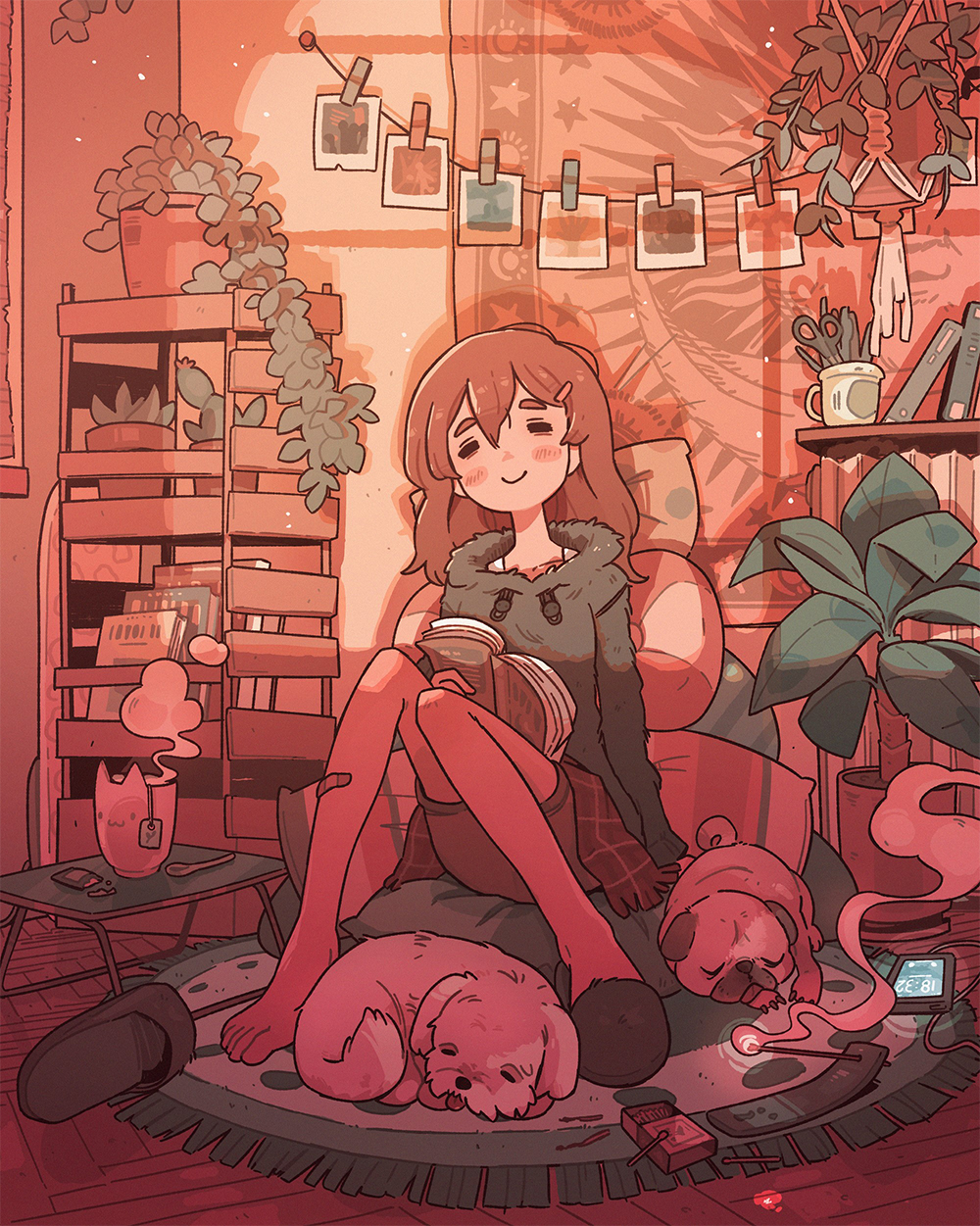
The drawing is consummate!
8. Image Formats and Exporting
I usually work on my illustrations keeping the format of Instagram images in mind. Instagram allows the following three formats (and variations between them):
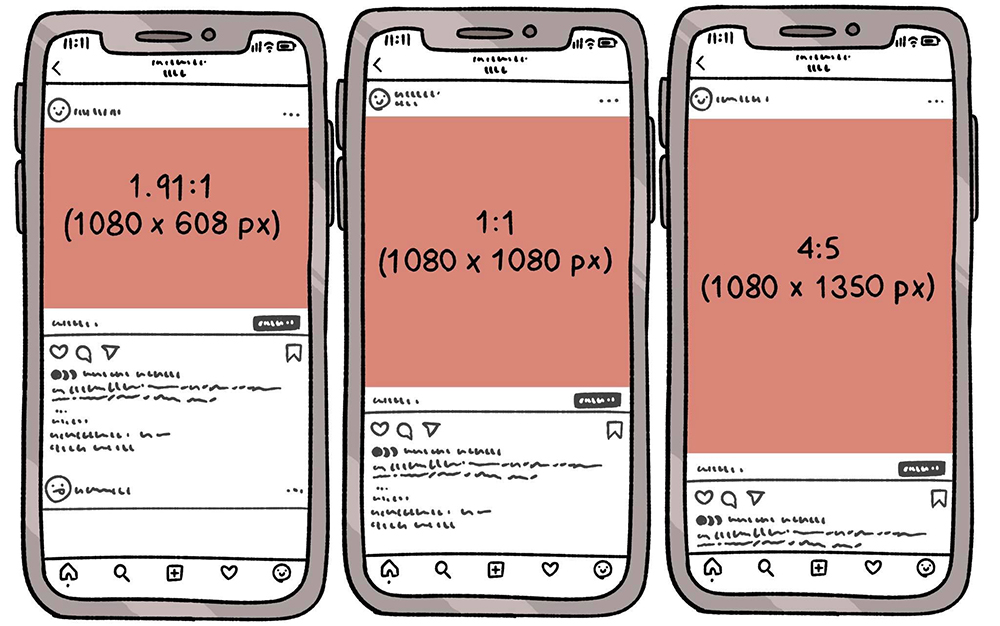
I choose one of these three formats and multiply information technology by 3. That is, if I want to go for a 1080 x 1080 px prototype, I'll make my canvass 3240 x 3240 px, this style the resolution is much higher than a smaller analogy when I export it (equally a PNG) to my phone to upload information technology to Instagram.

Source: https://www.clipstudio.net/how-to-draw/archives/164520
Posted by: garretttennesers69.blogspot.com
0 Response to "How Can I Get The Detail I Want In My Drawing"
Post a Comment