

How To Draw The Antiderivative Of A Function
4. Applications of Derivatives
iv.10 Antiderivatives
Learning Objectives
- Notice the general antiderivative of a given role.
- Explain the terms and notation used for an indefinite integral.
- State the power rule for integrals.
- Apply antidifferentiation to solve simple initial-value issues.
At this point, we have seen how to summate derivatives of many functions and have been introduced to a variety of their applications. We now ask a question that turns this process effectually: Given a function  how do nosotros notice a part with the derivative
  and why would we be interested in such a function?
We respond the first office of this question by defining antiderivatives. The antiderivative of a office is a function with a derivative  Why are we interested in antiderivatives? The need for antiderivatives arises in many situations, and we look at various examples throughout the rest of the text. Hither nosotros examine i specific example that involves rectilinear motility. In our exam in Derivatives of rectilinear motion, we showed that given a position function
  of an object, so its velocity function
  is the derivative of —that is,
  Furthermore, the dispatch
  is the derivative of the velocity —that is,
  At present suppose we are given an acceleration function
  but not the velocity part
  or the position office
  Since
Since  determining the velocity function requires u.s.a. to observe an antiderivative of the acceleration function. Then, since
  determining the position function requires united states to find an antiderivative of the velocity function. Rectilinear motion is only one case in which the need for antiderivatives arises. We will run into many more examples throughout the remainder of the text. For now, permit's look at the terminology and notation for antiderivatives, and determine the antiderivatives for several types of functions. Nosotros examine various techniques for finding antiderivatives of more complicated functions in the second volume of this text (Introduction to Techniques of Integration).
Indefinite Integrals
We now look at the formal note used to correspond antiderivatives and examine some of their properties. These backdrop allow us to find antiderivatives of more complicated functions. Given a function we use the annotation  or
or  to announce the derivative of Hither we introduce notation for antiderivatives. If
  is an antiderivative of nosotros say that
  is the most general antiderivative of and write

The symbol  is called an integral sign, and
  is called the indefinite integral of
Definition
Given a function the indefinite integral of denoted

is the nearly general antiderivative of If is an antiderivative of then
The expression  is called the integrand and the variable
  is the variable of integration.
Given the terminology introduced in this definition, the act of finding the antiderivatives of a function is ordinarily referred to every bit integrating
For a function and an antiderivative  the functions
  where
where  is any real number, is oftentimes referred to as the family of antiderivatives of For example, since
  is an antiderivative of
  and any antiderivative of is of the class
  we write

The collection of all functions of the class where is any real number, is known every bit the family unit of antiderivatives of  (Figure) shows a graph of this family of antiderivatives.
For some functions, evaluating indefinite integrals follows directly from properties of derivatives. For instance, for 

which comes directly from

This fact is known every bit the power dominion for integrals.
Power Dominion for Integrals
For

Evaluating indefinite integrals for some other functions is also a straightforward calculation. The following table lists the indefinite integrals for several common functions. A more complete list appears in Appendix B.
| Differentiation Formula | Indefinite Integral |
|---|---|
 |  |
 |  for for  |
 |  |
 |  |
 |  |
 |  |
 |  |
 |  |
 |  |
 |  |
 |  |
 |  |
 |  |
From the definition of indefinite integral of we know

if and merely if is an antiderivative of Therefore, when claiming that
information technology is important to check whether this statement is correct by verifying that 
Verifying an Indefinite Integral
Solution
- Since

the statement

is correct.
Note that we are verifying an indefinite integral for a sum. Furthermore, and
and  are antiderivatives of and
  respectively, and the sum of the antiderivatives is an antiderivative of the sum. We discuss this fact again later in this section.
 - Using the product dominion, we see that

Therefore, the statement

is correct.
Note that we are verifying an indefinite integral for a product. The antiderivative is not a production of the antiderivatives. Furthermore, the product of antiderivatives,
  is non an antiderivative of
  since
since
In full general, the product of antiderivatives is not an antiderivative of a product.
Verify that 
Solution

In (Figure), we listed the indefinite integrals for many unproblematic functions. Allow's at present turn our attention to evaluating indefinite integrals for more complicated functions. For case, consider finding an antiderivative of a sum  In (Figure)a. we showed that an antiderivative of the sum
  is given past the sum
  —that is, an antiderivative of a sum is given by a sum of antiderivatives. This result was not specific to this example. In general, if and
  are antiderivatives of any functions and
  respectively, then

Therefore,  is an antiderivative of
  and nosotros accept

Similarly,

In addition, consider the job of finding an antiderivative of  where
where  is any real number. Since

for whatever existent number  nosotros conclude that

These backdrop are summarized adjacent.
Properties of Indefinite Integrals
Let and be antiderivatives of and respectively, and permit be any real number.
Sums and Differences

Abiding Multiples

From this theorem, we can evaluate any integral involving a sum, difference, or constant multiple of functions with antiderivatives that are known. Evaluating integrals involving products, quotients, or compositions is more complicated (see (Figure)b. for an example involving an antiderivative of a product.) We look at and address integrals involving these more complicated functions in Introduction to Integration. In the next example, we examine how to employ this theorem to summate the indefinite integrals of several functions.
Evaluating Indefinite Integrals
Solution
- Using (Effigy), we tin integrate each of the four terms in the integrand separately. We obtain

From the second role of (Effigy), each coefficient can exist written in front end of the integral sign, which gives

Using the power rule for integrals, we conclude that

- Rewrite the integrand equally
![\frac{{x}^{2}+4\sqrt[3]{x}}{x}=\frac{{x}^{2}}{x}+\frac{4\sqrt[3]{x}}{x}=0.](https://opentextbc.ca/calculusv1openstax/wp-content/ql-cache/quicklatex.com-6b6d4b6631599dce2849e04edd72afdc_l3.png "Rendered by QuickLaTeX.com")
Then, to evaluate the integral, integrate each of these terms separately. Using the power rule, we take
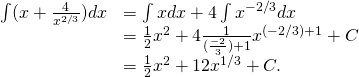
- Using (Figure), write the integral as

Then, use the fact that
 is an antiderivative of
  to conclude that
- Rewrite the integrand as

Therefore,

Evaluate 
Solution

Initial-Value Problems
We await at techniques for integrating a large variety of functions involving products, quotients, and compositions later in the text. Here we turn to one common use for antiderivatives that arises often in many applications: solving differential equations.
A differential equation is an equation that relates an unknown function and one or more of its derivatives. The equation

is a unproblematic example of a differential equation. Solving this equation means finding a part  with a derivative Therefore, the solutions of (Figure) are the antiderivatives of If is one antiderivative of every function of the form
  is a solution of that differential equation. For example, the solutions of

are given by

Sometimes we are interested in determining whether a particular solution curve passes through a certain point  —that is,
  The trouble of finding a function that satisfies a differential equation
with the additional status

is an instance of an initial-value problem. The condition is known as an initial status. For example, looking for a part that satisfies the differential equation
and the initial condition

is an example of an initial-value trouble. Since the solutions of the differential equation are  to find a function that likewise satisfies the initial status, we need to observe such that
  From this equation, we see that
  and nosotros conclude that
  is the solution of this initial-value problem as shown in the post-obit graph.
Solving an Initial-Value Trouble
Solve the initial-value problem

Solution
Beginning we need to solve the differential equation. If  then
then

Next we need to look for a solution that satisfies the initial condition. The initial status  ways nosotros demand a constant such that
  Therefore,

The solution of the initial-value problem is 
Solve the initial value trouble 
Solution

Initial-value problems arise in many applications. Next nosotros consider a problem in which a driver applies the brakes in a car. Nosotros are interested in how long it takes for the car to stop. Call up that the velocity role is the derivative of a position function  and the acceleration is the derivative of the velocity role. In earlier examples in the text, nosotros could summate the velocity from the position and so compute the acceleration from the velocity. In the next example nosotros piece of work the other fashion effectually. Given an acceleration function, we calculate the velocity function. We then employ the velocity function to determine the position function.
Decelerating Car
A car is traveling at the rate of 88 ft/sec  mph) when the brakes are practical. The motorcar begins decelerating at a constant rate of 15 ft/secii.
- How many seconds expire before the automobile stops?
- How far does the motorcar travel during that time?
Solution
- First we introduce variables for this problem. Let
 exist the time (in seconds) subsequently the brakes are start applied. Permit exist the dispatch of the car (in anxiety per seconds squared) at time
  Allow be the velocity of the car (in feet per second) at time Let be the car's position (in feet) across the point where the brakes are applied at time
The auto is traveling at a rate of Therefore, the initial velocity is
  ft/sec. Since the auto is decelerating, the acceleration is
The acceleration is the derivative of the velocity,

Therefore, we have an initial-value problem to solve:

Integrating, we find that

Since
 Thus, the velocity role is
To find how long it takes for the car to stop, we demand to find the fourth dimension
such that the velocity is zero. Solving  we obtain
  sec.
sec. - To find how far the car travels during this fourth dimension, nosotros need to find the position of the machine after
 sec. We know the velocity is the derivative of the position
  Consider the initial position to be
  Therefore, nosotros need to solve the initial-value problem
Integrating, nosotros have

Since
 the constant is
  Therefore, the position office is
After
sec, the position is  ft.
ft.
Suppose the car is traveling at the rate of 44 ft/sec. How long does information technology take for the car to end? How far will the car travel?
[reveal-answer q="923849″]Bear witness Answer[/reveal-answer]
[subconscious-answer a="923849″]
Key Concepts
For the following exercises, bear witness that  are antiderivatives of
one. 
Solution

2. 
3. 
Solution

4. 
5. 
Solution

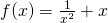
For the following exercises, find the antiderivative of the part.
6. 
7. 
Solution

8. 
9. 
Solution

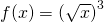
For the post-obit exercises, notice the antiderivative of each role
10. 
11. 
Solution

12. 
13. 
Solution

fourteen. 
15. 
Solution

16. 
17. 
Solution

eighteen. 
nineteen. 
Solution

20. 
21. 
Solution

22. 
23. 
[reveal-reply q="93930″]Show Reply[/reveal-answer]
[hidden-reply a="93930″]
24. 
25. 
Solution

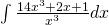
For the following exercises, evaluate the integral.
26. 
27. 
[reveal-answer q="436260″]Show Answer[/reveal-answer]
[subconscious-reply a="436260″]
28. 
29. 
Solution

xxx. 
31. ![\int (4\sqrt{x}+\sqrt[4]{x})dx](https://opentextbc.ca/calculusv1openstax/wp-content/ql-cache/quicklatex.com-b28630a84f34f3cf7c8d498f6eae83ce_l3.png "Rendered by QuickLaTeX.com")
Solution

32. 
33. 
Solution

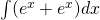
34. 
For the following exercises, solve the initial value problem.
35. 
Solution

36. 
37. 
Solution

38. 
39. 
Solution

For the post-obit exercises, observe 2 possible functions given the 2d- or third-lodge derivatives.
40. 
41. 
Solution
Answers may vary; one possible respond is 
42. 
43. 
Answers may vary; one possible answer is 
44. 
45.A machine is being driven at a rate of 40 mph when the brakes are applied. The car decelerates at a constant charge per unit of 10 ft/sectwo. How long earlier the car stops?
46.In the preceding problem, calculate how far the motorcar travels in the fourth dimension it takes to finish.
47.You are merging onto the state highway, accelerating at a constant rate of 12 ft/sec2. How long does it take you to reach merging speed at 60 mph?
48.Based on the previous problem, how far does the car travel to reach merging speed?
49.A automobile company wants to ensure its newest model can stop in 8 sec when traveling at 75 mph. If we presume constant deceleration, find the value of deceleration that accomplishes this.
fifty.A automobile company wants to ensure its newest model tin cease in less than 450 ft when traveling at threescore mph. If we assume constant deceleration, discover the value of deceleration that accomplishes this.
For the following exercises, find the antiderivative of the function, assuming 
51. [T] 
Solution

52. [T] 
53. [T] 
[reveal-answer q="814324″]Prove Answer[/reveal-answer]
[hidden-answer a="814324″]
54. [T] 
55. [T] 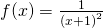
Solution

56. [T] 
For the post-obit exercises, decide whether the statement is true or false. Either prove it is true or find a counterexample if it is false.

Source: https://opentextbc.ca/calculusv1openstax/chapter/antiderivatives/
Posted by: garretttennesers69.blogspot.com
0 Response to "How To Draw The Antiderivative Of A Function"
Post a Comment